
By John Gordon, in partnership with Uncertainty Experts.
Your L&D team knows AI matters. They have seen the headlines. They have sat through the presentations. Many have tried tools. So why are you not seeing change?
It is not a technology problem. It is a behaviour problem. And until you understand the behaviour, no amount of AI tools will make a difference.
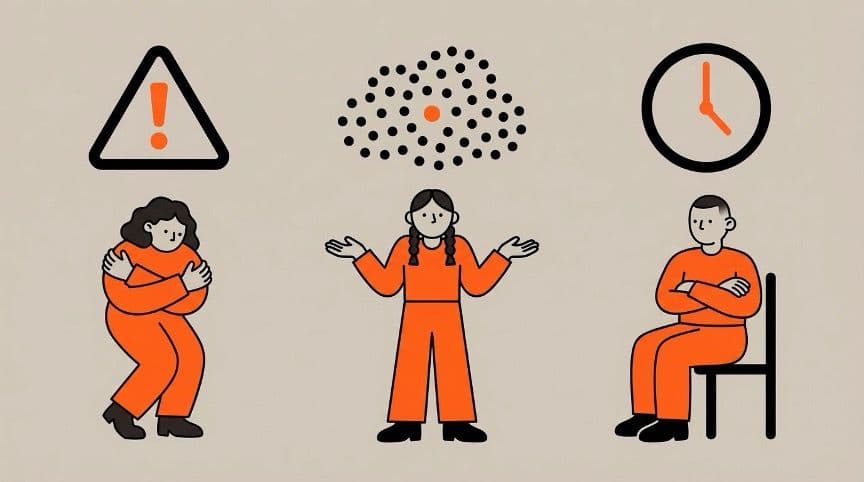
Over the past four years, Uncertainty Experts (a behavioural science programme working with UCL, recently acquired by Mediazoo) have studied how 20,000 participants across 28 countries respond to uncertainty. Their findings, published by The Royal Society, reveal three patterns that appear every time people face the unknown: Fear, Fog, and Stasis. We see all three whenever we talk to L&D teams about AI.
Fear: "AI will replace us"
 Fear shows up when a team sees AI as a direct threat to their roles and professional identity. It looks like avoidance and defensiveness.
You have heard the arguments. "The risks are too high." "We are not ready." Behind each statement sits a genuine concern: if a machine can do my work, what happens to me?
The concern is not irrational. AI anxiety is rising across professions, with L&D roles particularly affected. And 62% of entry-level AI adopters report burnout, giving weight to the worry that AI creates more pressure, not less.
But the data also shows something else: the professionals who build AI skills early do not lose their roles. They move into more strategic work. They stop spending hours on production tasks and start spending that time on work that actually requires human judgement: designing learning experiences, coaching stakeholders, shaping strategy. They become agent orchestrators, directing and governing AI rather than competing with it.
AI amplifies learning expertise. It does not replace it. The L&D professional who can direct an AI to build a needs analysis in 20 minutes instead of two days is not less valuable. They are dramatically more valuable. Their judgement and understanding of the organisation become the scarce resource.
If your team is in Fear, show them what AI-augmented L&D work actually looks like. Show them the tasks that get automated (the tedious ones) and the tasks that grow (the interesting ones).
Fog: "Too many tools, no clear path"
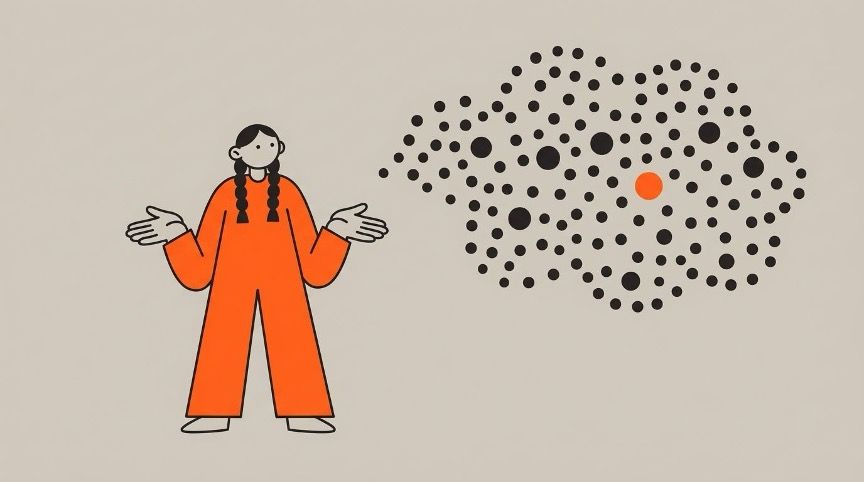 Fog is not resistance. Teams in Fog are genuinely trying to figure it out. But the volume of information stops them making progress.
The numbers tell the story. Most professionals are already using AI in some form, but almost none have a structured plan for how to use it. Shadow AI (people using unapproved tools without organisational knowledge or governance) has become the norm. Everyone is experimenting. Nobody has a map.
The result is paralysis by options. Teams evaluate 20 tools and adopt very little. They run a ChatGPT workshop, get excited for a week, then go back to old workflows. Someone builds a comparison spreadsheet that grows to 47 rows. It never leads to a decision.
Fog responds to clarity and structure, not more input. The answer is not another webinar or another 50-page AI strategy document. The answer is a framework: one clear path that tells you which skills exist, which ones matter for your role, and what order to build them in.
That is why we built AI Skill Packs. Not because frameworks are exciting (they are not), but because a team in Fog needs one path, not 47 options.
Stasis: "We know. We just have not acted."
 Uncertainty Experts' research includes a striking finding: when given the choice between receiving an electric shock and simply waiting in uncertainty, 80% of participants chose the shock. Not one person could endure an hour of uncertain waiting. People will take physical pain over sitting with the unknown.
Yet organisations routinely choose months of uncertain waiting on AI. Not because they decided to wait, but because nobody decided to start.
A team in Stasis knows AI matters. They agreed on its importance months ago. They formed a working group and commissioned a report. But their actual workflows have not changed. No new skills built. No measurable impact.
The macro data confirms this is widespread. 56% of CEOs report generating no measurable value from AI investments. 89% of organisations report zero measurable productivity impact. These are not organisations that ignored AI. They invested. They bought tools. They just never built the capability to use them.
Stasis is knowing without doing. And it is self-reinforcing. The longer you wait, the more normal waiting feels.
The cost is already accumulating
We see between one and two days saved per person per week when we deploy AI capability programmes internally. That is not a projection. That is what happens when people get the right skills and a clear framework.
For a team of 10, the gap between doing nothing and running a structured programme is roughly 120 hours per week. Over six months, that adds up to more than 3,000 hours of productive capacity sitting unused.
Every week your team stays in Fear, Fog, or Stasis, that gap widens.
What to do about it
Fear responds to evidence and safety. Fog responds to clarity and structure. Stasis responds to urgency and social proof. But all three share a common first step: understand where your team actually stands.
Article 2 maps the technical landscape behind these three states: Skills, MCP, and Markdown. Three pillars. Three convergences. Three reasons the window for action is narrowing.
The Finer Vision AI Maturity Assessment is free and takes 10 minutes. It surfaces which of the three patterns are present in your organisation and gives you specific recommendations for what to do next, including which AI Skill Packs to prioritise.
You do not need to buy anything. You do not need to commit to anything. You just need to know where you stand. Remember: 80% of people chose the electric shock over waiting. Do not let your team be the organisation that chose to wait.
Take the free AI Maturity Assessment at https://finervision.com/assessment
References
1. Uncertainty Experts / UCL. Fear, Fog, Stasis behavioural patterns. 20,000+ participants across 28 countries. Published by The Royal Society.
2. Nature's Scientific Reports (2026). AI anxiety rising across professions, L&D roles particularly affected.
3. UC Berkeley / Harvard Business Review (February 2026). 62% of entry-level AI adopters report burnout.
4. PwC (January 2026). 29th Global CEO Survey. 56% of CEOs no measurable value from AI.
5. National Bureau of Economic Research (February 2026). "Firm Data on AI" (w34836). 89% report no productivity impact.